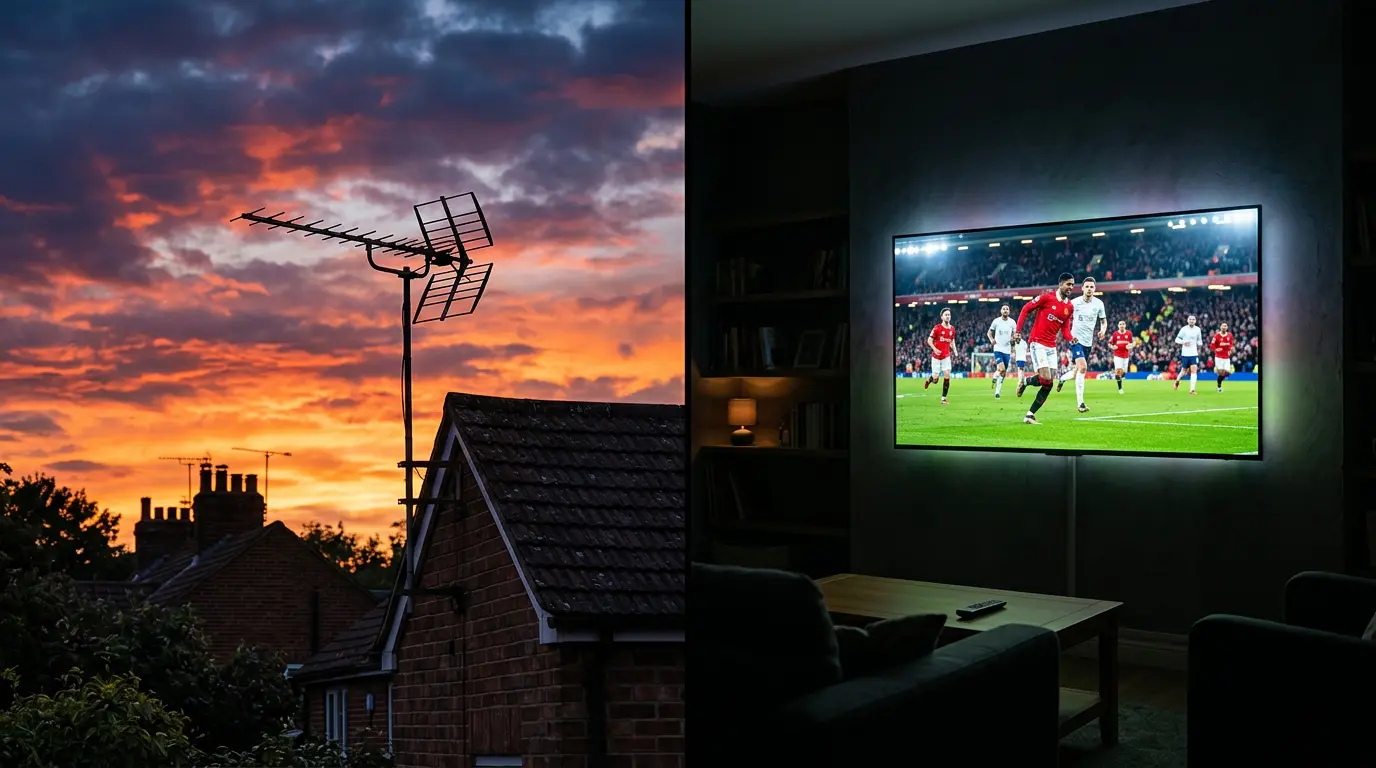
Freeview has been a staple of British living rooms for over two decades. It’s free, it works, and most UK TVs come with it built in. But here’s the thing — the way people actually watch television has changed completely, and Freeview has barely moved. No sports beyond what’s on free channels. No on-demand library worth talking about. Signal that drops when the weather turns. And a channel count that looks impressive until you realise half of them are shopping channels.
More and more UK households are asking whether IPTV is the logical next step. And for most people, the honest answer is yes — not because Freeview is terrible, but because IPTV does everything Freeview does and a lot more besides, for a monthly cost that most households barely notice.
This article breaks down the comparison properly. No hype, no technical jargon — just a straight answer to whether IPTV is worth making the switch from Freeview in 2026.
What Freeview Actually Is — and What It Isn’t
Freeview is a free-to-air digital television service delivered via a rooftop aerial or built-in TV tuner. It carries the major UK broadcasters — BBC, ITV, Channel 4, Channel 5, and a collection of smaller channels — without any subscription fee. In the UK, most smart TVs have Freeview built in, which means millions of households use it every day without even thinking about it.
What Freeview does well is deliver the core UK broadcasting experience at zero cost. If you want BBC One, ITV, Channel 4, and Channel 5 live with no monthly bill, Freeview is the obvious answer. Freeview Play added basic catch-up functionality, which made it more useful. And for casual viewers who mainly watch the flagship channels, Freeview genuinely does the job.
But Freeview has real limits that become obvious the moment you want anything beyond the basics. No Sky Sports, no TNT Sports, no BT Sport. No international channels. No significant VOD library. Signal quality that depends on your aerial, your location, and whatever the weather is doing. And perhaps most importantly — no sports beyond what happens to be on BBC or ITV on any given evening.
What IPTV Gives You That Freeview Simply Cannot
This is where the comparison stops being close. IPTV — Internet Protocol Television — delivers television over your broadband connection rather than through an aerial. That one difference unlocks an entirely different level of content, quality, and flexibility.
Every UK Channel, Live and in HD
A quality best IPTV service in UK includes every Freeview channel you already watch — BBC One, BBC Two, ITV, Channel 4, Channel 5 — plus hundreds more. The difference is these come through your broadband rather than your aerial, which means no signal dropouts, no pixelation during bad weather, and consistent HD quality regardless of where you live in the UK. Rural households that have lived with a patchy Freeview signal for years often find this alone worth the switch.
Live Sports — the Biggest Gap
Freeview’s sports coverage is limited to whatever BBC and ITV broadcast — some international football, the occasional boxing match, athletics. Everything else — Premier League, Champions League, F1, boxing pay-per-views, cricket Test matches — is behind a paywall on Sky, TNT Sports, or BT Sport. A quality IPTV service includes all of these sports channels live. For any household that watches sport seriously, this is not a minor upgrade. It changes the entire viewing experience.
A Massive On-Demand Library
Freeview Play’s catch-up functionality covers the main UK broadcasters and works reasonably well. But it is not a VOD library by any modern definition. A quality IPTV service comes with an on-demand library of tens of thousands of films and TV series — content from across UK and international broadcasters that goes far beyond anything Freeview has ever offered.
Multi-Device Viewing
Freeview is tied to your television aerial point. IPTV works on your smart TV, Firestick, phone, tablet, and laptop — simultaneously if your subscription includes multiple connections. For modern households where different family members want to watch different things on different screens, IPTV’s flexibility is not just convenient. It’s practically necessary.
No Aerial, No Signal Problems
A Freeview signal is only as good as your aerial, your local transmitter, and the distance between them. Households in rural areas, in flats, or in areas with poor reception know the frustration of a pixelated picture that clears up just in time for the credits. IPTV bypasses all of this entirely. As long as your broadband connection is stable, your picture is stable. Full stop.
Where Freeview Still Has an Edge
A fair comparison means acknowledging what Freeview genuinely does better. There are two areas where Freeview is hard to beat.
It’s Free — Completely and Genuinely
Freeview costs nothing beyond owning a compatible TV or a £20 set-top box. No monthly subscription, no contract, no payment details required. For households on a genuinely tight budget who mainly watch BBC, ITV, and Channel 4, Freeview is an entirely reasonable choice that costs nothing to run.
It’s Simpler to Use for Non-Tech Households
Turn on the TV, press a number, watch. Freeview requires no apps, no usernames, no M3U links, no EPG configuration. For older viewers or households that genuinely just want the basics without any setup, Freeview’s simplicity is a real advantage. IPTV has become significantly more user-friendly in recent years — but it still requires a slightly more involved setup than a Freeview television.
If you are ready to move beyond Freeview and want a single service that covers everything Freeview does — and everything it cannot — Golden TV is the service UK viewers keep coming back to. Full BBC, ITV, Channel 4 and Channel 5 live, plus sports channels, international content, catch-up, and a VOD library Freeview could never touch. And unlike an aerial that gives up the moment a lorry drives past, the streams are stable, consistent, and available on every device you own. Reach out on WhatsApp before you commit — the team responds fast and will answer every question you have.

*Recommended based on user feedback from UK IPTV communities. We do not operate or sell IPTV services directly.
The Cost Comparison — What You Actually Pay
Freeview is free. IPTV costs money. On the surface, Freeview wins on price immediately. But look at the complete picture and the maths becomes more interesting.
If you are currently watching Freeview and also paying for Sky Sports (around £20/month), TNT Sports (around £30/month), Netflix (around £11/month), and a broadband TV bundle — you could be spending £60–90 per month on television. A quality best IPTV service in uk at £10–20 per month replaces Sky Sports, TNT Sports, and a significant VOD library in a single subscription. Add Netflix if you want specific originals and you are still well below your current total.
If you are a pure Freeview household who genuinely only watches BBC, ITV, and Channel 4, and has no interest in sport or international content — Freeview is probably the right answer for you. But the moment you add any paid subscription on top of Freeview, IPTV almost certainly makes more financial sense.
For a full breakdown of what a quality subscription includes, see our best IPTV service in UK guide and our best IPTV subscription in UK guide. For sports-specific coverage, see our best IPTV for sports UK guide.
Is the UK Moving Away from Freeview Entirely?
This is not just a question for individual households — it’s a question the UK government is actively considering. The UK’s broadcasting regulator and government have been discussing a potential ‘digital switchover’ from terrestrial Freeview to IPTV-based delivery, potentially beginning in 2035 with completion in the years that follow.
The direction of travel is clear: IPTV is the future of UK television delivery. Freeview will continue to serve millions of households for years to come, but the infrastructure investment is going into broadband and IPTV, not into aerial networks. Getting comfortable with IPTV now — while Freeview is still available as a fallback — is a sensible move for any UK household.
The UK’s broadband rollout is making IPTV accessible to increasingly rural areas that previously relied on Freeview out of necessity rather than choice. As coverage improves, the practical case for IPTV over Freeview only gets stronger.
Frequently Asked Questions – IPTV vs Freeview UK
Is IPTV better than Freeview in the UK?
For most UK viewers, yes — IPTV offers significantly more content, better picture quality, live sports that Freeview cannot provide, multi-device support, and no aerial dependence. The only area where Freeview is genuinely better is cost — it is free, while IPTV requires a monthly subscription. If you only watch BBC, ITV, and Channel 4 and have no interest in sport or extra content, Freeview does the job at no cost. For everyone else, IPTV is the clear upgrade.
Can IPTV replace Freeview in the UK?
Yes, completely. A quality IPTV service includes every Freeview channel live — BBC One, BBC Two, ITV, Channel 4, Channel 5 — plus hundreds of additional channels, live sports, and a VOD library. There is nothing in the Freeview lineup that IPTV does not also provide, along with considerably more.
Do I need to keep my aerial if I switch to IPTV?
No. IPTV delivers all channels through your broadband connection. Your aerial becomes redundant the moment you switch. Some households keep it as a backup in case of broadband outages, but for day-to-day viewing an aerial is not needed when using a quality IPTV service.
Is IPTV free like Freeview?
No. IPTV requires a monthly subscription, typically £10–20 for a quality service. The significant difference is what you get for that money — live sports, hundreds of channels, international content, and a VOD library that Freeview could never offer. For households already paying for Sky Sports or TNT Sports on top of Freeview, switching to IPTV typically saves money overall.
Does IPTV work without an aerial?
Yes — this is one of IPTV’s key advantages. All content is delivered through your broadband connection. No aerial is required. IPTV works anywhere in the UK with a broadband connection, regardless of aerial signal strength or local transmitter quality. Rural households with poor Freeview reception often find IPTV delivers a dramatically better picture quality.
Will Freeview be switched off in the UK?
The UK government is actively considering a switchover from terrestrial Freeview to IPTV-based delivery, potentially beginning around 2035. No firm date has been set and Freeview will continue operating for years to come. However, the direction of travel in UK broadcasting policy is clearly toward IPTV as the long-term delivery mechanism for UK television.
What broadband speed do I need to use IPTV instead of Freeview?
A minimum of 10–15 Mbps download speed is sufficient for stable HD IPTV streaming. For 4K content, 25 Mbps or above is recommended. Most UK broadband connections in 2026 comfortably exceed these thresholds. A wired ethernet connection is always preferable to WiFi for live TV viewing.
Final Verdict – Should You Switch from Freeview to IPTV?
If you only watch BBC, ITV, and Channel 4 and never pay for any additional TV subscription — stay on Freeview. It costs nothing and does exactly what you need.
If you watch sport, if you have a paid sports subscription on top of Freeview, if you want a VOD library, if you want international channels, if you want multi-device viewing, or if you live somewhere with a poor aerial signal — switch to IPTV. You will pay a modest monthly fee and gain a level of content, quality, and flexibility that Freeview cannot come close to matching.
The UK is moving toward IPTV. The question is whether you get ahead of that transition now, or wait until Freeview starts switching off aerials in the 2030s.
Disclosure: This site recommends third-party services based on user feedback and research. We do not operate, sell, or provide IPTV services directly. All trademarks belong to their respective owners.